Monday, February 2, 2015

Unit 4: Blog Summary

Welcome back, my physics friends! I know it's been a while, but do not fear! I'm back in session now and have a great unit for you. In this new unit we learned about four more key and exciting concepts in physics....

1.) Rotational and Tangential Velocity

2.) Rotational Inertia and Conservation of Angular Momentum

3,) Torque and  Center of Mass/ Gravity

4.) Centripetal and Centrifugal Force

Just like in the last semester's units, I learned of numerous formulas, concepts and everyday applications. What sets this unit apart is that it was generally exciting to find things out such as why a train doesn't run off the tracks or why an ice skater goes faster when they pull their arms in. All of this and more will be answered below.

Part one: Rotational and Tangential Velocity

1.) What is tangential speed?

It is the direction of motion tangent to the circumference, the linear speed of something moving along a circular path.

2.) What are the units it's measure in?

It is measured in m/s or km/h. 

3.) Does tangential speed depend on the radial distance (distance from the axis)?

Yes, yes it does.

4.) What tangential speed directly related to?

It is directly related to rotational speed.

5.)  What does rotational speed involve?

It involves the number of rotations or revolutions per unit of time.

6.) What do all parts share?

They share the same rate of rotation/ number of rotations/revolutions.

7.) What unit is rotational velocity measure in?

It is measured in RPM's ( revolutions per minute).

8.) Is there speed in the center of the rotating platform?

No, there is not speed, just rotational.

9.) Keep this in mind...


Examples and Practice Problems (Some exercises from our textbook) 

1.) How are train wheel designed so they stay on the track?

Train wheels are tapered with the fat/wider part on the middle, the more narrow part on the outside. All parts of the wheel gave the same rotational speed, but the wider part has a greater tangential speed. This difference causes the wheels to curve when the wider part is on the track. The wheels curve inward, setting the train in the middle when it is in the middle of the track.

2.)  Look at the adorable kids on the merry-go-round. Specifically look at the girl sitting down (kid a) and the boy sitting behind her to her right (kid b). Which kid has the greater....


a.) Tangential velocity and why?

Kid B has the greater tangential because he is farther from the axis of rotation. 

b.) Rotational velocity and why? 

They have the same rotational velocity because their distance to the axis of rotation doesn't matter. They will have the same number of rotations around the merry go round. 


2.) An automobile speedometer is configured to read speed proportional to the rotational speed of its wheels. If larger wheels, such as those of snow tires,are used, will the speedometer reading be high, low- or no different?

Lower because the bigger wheel will cover more distance per revolution and the speedometer is only accounting for the revolutions for the smaller tire. 


3.) Fill in the blanks for the following....

a.) Gears work by having the same ________ velocity, but different ________ velocity. 


b.)  Train wheels autocorrect by having the same ________ velocity, but different ________ velocity. 

Answer for a: tangential/ rotational 

Answer for b: rotational/tangential 


Part two- Rotational Inertia and Conservation of Angular Momentum 

1.) What is rotational inertia?

The property of an object to resist changes to spin, A.K.A how much an object is willing to spin. 

2.)  What causes it to increase or decrease (i.e what does it depend on)?

The location of the mass in relation to the axis of rotation. 

3.) What does the conservation of rotational/angular momentum mean? 

It means once you start to spin you will continue to spin. 

4.) What two things affect the amount of rotational/angular momentum? 

The two things that affect it are rotational velocity and rotational inertia. 

5.) If something has a high amount of rotational inertia, will it be more or less likely to spin? 

It will be less likely to spin. 


Examples and Practice Problems (Some exercises taken from our  textbook) 

1.) Why was the meter stick with the masses closer to center easier to rotate?

It has a small amount of rotational inertia so it is easier to rotate. 

2.) Why do runners bend their legs when they run rather than keeping them outstretched?

They bend their legs because it brings their mass closer to their axis of rotation, decreasing their rotational inertia.

3.) An ice skater is spinning with his arms close to his body. Is his rotational inertia high or low? Is his rotational velocity high or low?

His rotational inertia is low. His rotational velocity is high. 

4.) The same ice skater now stretches his arms outward. What happens to his rotational inertia? What can you predict will happen to his rotational velocity? 

His rotational inertia is high. His rotational velocity is low. 

5.) Which would win a race down a ramp - a solid steel ball or a hoop and why?

The solid steel would win the race, believe it or not. The ball would win because its mass it closer to the center versus the hoop whose mass is more concentrated toward the outside. 

6.) Which would win a race down a ramp - a frozen bottle of water or an unfrozen bottle of water and       why? 

The frozen water bottle would win because it, like the steel ball, has it's mass concentrated in the center. On the other hand, the unfrozen water bottle's mass isn't solid and is moving around the outside of the water battle rather than remaining in the center. 

7.) Why are lightweight tires preferred over lightweight frames in bicycle racing?

Hopefully you know the answer by now! However, just in case, I will write it out. The light weight tires mean you have a low rotational inertia so it will spoon easier. When you have a heavy frame the mass will be away from the axis of rotation, so it will remain in the middle A.K.A less likely to rotate. 

8.) A large amount of soil is washed down from the Mississippi river to the Gulf of Mexico each year. What effect does this have on the length of the day? 

The day would get longer. 

Part three- Torque and Center of Mass/ Gravity 

1.) What does a torque cause?

It causes rotation. 

2.) What two things does torque require (i.e What is torque equal to)?

It requires a force and lever arm. 

3.) What is the formula to find the torque of an object?

Torque= Force x Lever Arm 

4.) What is a lever arm? 

It is the distance from the axis of rotation to where the force is applied. 

5.) When something is balanced, what do I know about the clockwise and counter clockwise torques?

 They are equal. 

6.) What are three different ways you could get a large torque?

 You can increase your lever arm, force, or both. 

7.) How can you have a large torque without having a large force (i.e How can a very small force cause a large torque)? 

If you have a large lever arm then you only need to apply a small force to get a large torque. 

8.) What is the center of mass? 

The average position of an objects mass. 

9.) What is the center of gravity?

The specific point on all objects that gravity acts on. 

10.) What two things cause you to be more stable?

The two things that cause you to be more stable are lowering your center of gravity and widening your base of support. 

11.) What will an object need to do in order to fall over? 

An object will need to rotate outside of its base of support. 

Examples and Practice Problems (Some exercises taken from our textbook) 

1.) Why do more objects tip over when the center of gravity us not over their base of support?

This is because it creates a lever arm, which combined with force creates a torque. Torque causes rotation. 

2.) Why is putting a door stop closer to the handle better than putting it close to the hinge? 

By putting the door stop closer to the handle, the lever arm is lengthened which requires less force than if the lever arm was smaller. 

3.)  Why do wrestlers bend their knees and have their feet shoulder width apart when wrestling?

They do this to lower their center of gravity and increase their base of support. The wider base of support and lower center of gravity makes it harder to rotate outside of the base of support, in turn making them more stable. 

4.) Where would you place your finger if you were trying to balance a hammer and/or a broom?

For a hammer or broom you place it near the head of the tool. You place it near the head of the top because that is where the center of gravity is. The lever arm then doesn't need to be nearly as long to equalize the counterclockwise and clockwise torques. 

5.) The rock and the meter stick balance at the 25cm mark, in the picture below. The meter stick has a mass of 1kg. What must be the mass of the rock?


Answer....


6.) Is the net torque changed when a partner on a seesaw stands of hangs from her end instead of sitting? (Does the weight of the lever arm change?)

No, it does not change. 

7.) Can a force produce a torque when there is no lever arm? 

No, it cannot because the formula for Torque = Force x Lever Arm. 

8.) Why is a long pole more beneficial to a tightrope walker if the pole droops? 

It is more beneficial because it widens his base of support, making it harder for him to rotate out of it. 

9.) The center of gravity of the three trucks parked on a hill are shown by the X's. Which truck(s) will tip over? 


It will be the first one because when you draw a line from the red x then went diagonally, only the last two truck's lines would be over the base of support. 

10.) A long tack balanced like a seesaw supports a golf ball and a more massive billiard ball with a compressed spring between the two. When the spring is released, the balls move away from each other. Does the track tip clockwise, tip counterclockwise, or remain in the balance as the balls roll outward? 


It will remain balanced because the counterclockwise and clockwise torques are equal. The torques are equal because the billiard ball will have a big force, but a short lever arm, The golf ball will have a small force with a large lever arm. 

11.) Why are football players less likely to be pushed over when they keep their legs shoulder width wide vs. feet together?

They are less likely to be pushed over because they have a wider base of support. When they have a wider base of support it is harder to rotate outside of it.

12.) A long stick is balanced as is shown below. What is the weight of the stick? (show work)


Part four- Centripetal and Centrifugal force 

1.) What is a centripetal force?

It is a center seeking force.

2.) What is a centrifugal force?

It is a lie! This is because it is a fictitious force.


Here is an example of centripetal force to give you an idea of what that might look like..


3.) The velocity of an object is always ________ to the circle?

Answer: Tangent

4.) What force causes you to fling out when turning in a car?

It is the centripetal force.

Examples and Practice Problems (Some exercises from our textbook) 

1.) What force causes the water to fling out in a salad spinner whilst spinning it? (See the video below  if you are unaware of what a salad spinner is, looks like, or how it functions.) (Answer is posted below video.)


It is the absence of centripetal force on the water. This is because if there were centripetal force then the water would curve when it flew out instead of going straight. Centripetal force is the key component in something wanting to curve. 

2.) Describe the force that keeps you in the car when turning: what is it, what direction does it act, and how does this work?

The force is centripetal force. It acts in the inward direction because it is a center seeking force. 

3.) What direction does an object move in a circle compared to the force exerted on it that keeps it in the circle? (see picture in question number 8)

It moves tangent to the circle. 

4.) Why are race track curves built at an angle?

They are built at an angle because the F weight and F support add up to create a centripetal force which keeps the driver and the car on the track.


5.) Can an object move along a curved path if no force acts on it? Explain

6.) You are on a race track and it's been snowing! The ground is covered in a thin layer of frost and friction is need for you to round the curve of the final lap! If the track is banked, friction may not be needed at all. What, then, supplies the needed centripetal force?

The F support and F weight supplies the needed centripetal force. 

7.) Are satellites stationary above the earth? How do they stay close to the earth without flying into space and also not hitting the earth?

No, they're not stationary. They stay close to the earth because they're given a certain velocity, not too fast or too slow, so that the centripetal force of gravity pulls it in close to the earth.

8.) Label the centripetal force and the tangential velocity below and it's direction....


Answer.... 


9.) The car below is on a banked racetrack. There is a centripetal force acting on this car keeping it on the track. With labeled vectors, show where this centripetal force comes from.  


Answer... 


With a flying object it is similar, but with one small difference. See if you can spot the difference..... 
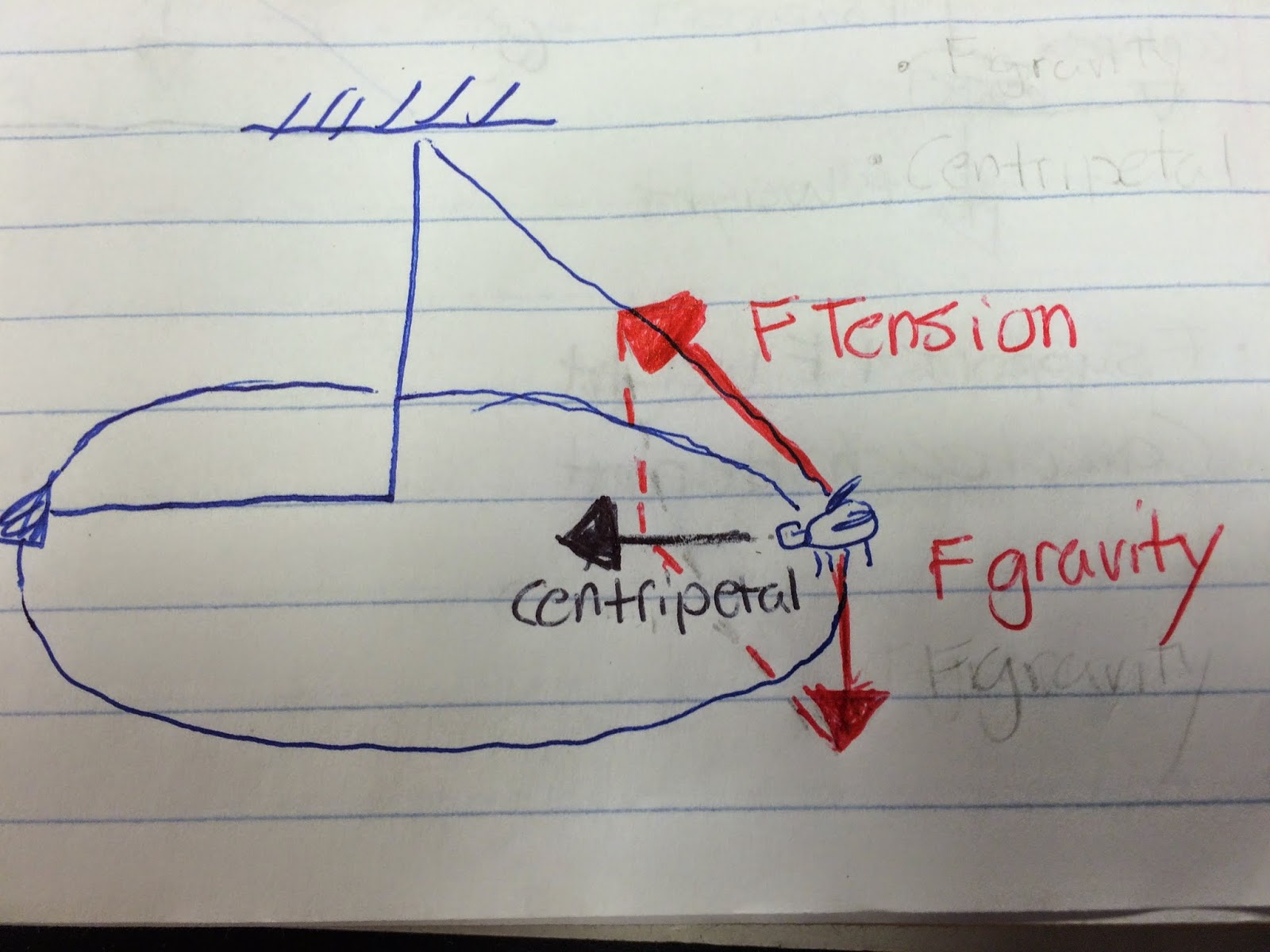


Answer: The difference is that there is no F support. Instead of F support, there is F tension.

You made it to the end! I know that was a lot of work, but you are made better for it! 

Thursday, January 29, 2015

Finding the Mass of a Meter Stick without using a Scale

Goal of assignment: Find the mass of a meter stick using only a meter stick and a 100g lead weight. 

Our reminders: 

a.) convert g to Kg 

b.) Use 9.8 when converting mass to weight 

Step 1- Demo 

A.) The meter stock is not balanced on the edge of the table and has a torque. Below is a picture of the meter stick with labels such as the force and lever arm that cause the torque.


B.) Now the meter stick is balanced on the edge of the table. What do you now know about the relationship between the edge of the table and the center of gravity? Refer to the picture below for answer. 

Answer: The edge of the table is where the center of gravity is, when the meter stick is balanced.


C.) Now see how the balance point changes when the 100g mass is added to the end of the meter stick. Refer to the picture below to see the forces and lever arms that are causing the clockwise and counterclockwise torques. (Hint: has the center of mass of the meter stick itself changed just because we added the mass to the end?)


Step 2- Planning 

In this section I will list:

A.) the equations used

B.) measurements taken

C.) reasoning behind my choices


A.) Equations

- Torque= F x Lever Arm (Torque= Force x Lever Arm)

- w=m x g (Weight= Mass x Gravity)

B.) Measurements taken

- Length of the lever arms
- weight of the added weight

C.)  Reasoning behind my choices

I choose the equation, w=mg, because I need to convert the weight of the added weight. That will let me know how much force is acting on the meter stick besides gravity. I need to have the equation,
Torque= F x Lever arm, because I need to find out the force of the side where the weight will not be placed. I need to find the length of the lever arms because I need that to figure out the torque. Finally, I need the weight of the added weight because I need to know how much force is acting on the side where the weight will be placed.

Step 3- Trying our plan out 

In this section, I will list out the steps we took.


1.) Plugged the weight of the added weight, after we converted it from grams to kilograms, into the equations w=mg. Remember 9.8 is the measure of the force of gravity!

- w= (1kg)(9.8)

- w= 0.98


2.) Found the center of gravity/ center of mass

- 50cm

3.) Measured the lever arms

    - Lever arm 1: 30.8 cm

   - Lever arm 2: 19.2 cm

4.) Plugged the lever arm with the added weight into the equation: Torque= F x Lever Arm (write out torquer and lever arm)

    - Torque= (0.98) x (30.8)

    - Torque= 30.18

5.) Since, we knew that the counter clockwise and clockwise torques are equal, we then knew to set the torque of the added weight equal to the side of the stick without the added weight multiplied by the unknown force.


6.) We then had to convert the new known force to mass.


7.) Once we got the mass, we had to convert the kilograms into grams. 


Results 

After getting our educated guess, we weighed the meter stick. The meter stick was 147.6g. We were off by 13.6 grams. Overall successful, but not as successful as I would've liked our experiment to be. 

See below for a picture of our final! Make note that it is balanced because the center of gravity is inside the base of support, which is the table. As pointed out before, the edge of the table is where the center of gravity is. 


Thursday, January 22, 2015

Center of Mass/Gravity

http://dev.physicslab.org/Document.aspx?doctype=3&filename=RotaryMotion_CenterMass.xml

The attached website beautifully lays out the definitions with pin point examples. In fact many of the examples we have seen in class. Therefore this should not be anything new, rather a reminder. They first begin with defining the center of mass as "the point where all of the mass of the object is concentrated." They then state that when an object is at equilibrium or balanced, then there is not net force. That little piece of info is something from a previous concept that I had forgotten, but was reminded of here. Now towards the bottom of the website, they explain that the pivot point or the axis or rotation must remain above the center of gravity, otherwise the object will no longer be in a state of equilibrium. Overall, a great site with terrific explanations to common examples.

Conservation of Angular momentum

http://www.pbs.org/opb/circus/classroom/circus-physics/angular-momentum/

In this website, they show a live example of acrobats spinning through the air while explaining the physics behind it. The provide the formula "L= lw" which states that angular momentum is Rotational Inertia multiplied by the Rotational velocity. However, since angular momentum must be conserved, as rotational inertia increase then the velocity must decrease and vice versa. Finally they state how the closer their masses were to the axis of rotation, the faster their rotation velocity is. This is also shown in the video along with the flying acrobats. An entertaining video, while also educational!

Monday, December 8, 2014

Unit 3 Summary

Hey physics fanatics, I'm back again! It's time to sum up what our class learned about in unit three. In this unit, I learned about 6 critical concepts...

1.) Newton's 3rd Law + Action/Reaction- Pairs

2.) Tug of War/ Horse and Buggy

3.) Forces in Perpendicular directions

4.) Gravity and Tides

5.) Momentum+ Impulse relationship

6.) Conservation of Momentum (including the lab)

In each of these concepts, I learned an exceptional amount of formulas, information, and applications to everyday situations. As usual, to avoid confusion, I'm going to break it down into sections. However, what'll be different about this section is that I will include more exercises from the textbook our class uses. The exercises help to test your knowledge and whether or not you retained any of the actual information I included in this unit summary. Don't panic, I will also have my usual crazy made up problems, to leave you with a little smile!

Part One: Newton's 3rd Law + Action/Reaction- Pairs 

1.) What is Newton's 3rd Law?

For every action there is an equal and opposite reaction.

2.) What is the relationship between acceleration and force?

They are directly proportional.

3.) What is the relationship between acceleration and mass?

They are inversely proportional.

4.) What would an action reaction pair look like?

Apple pulls Earth up
Earth pulls apple down

5.) What do action reaction pairs have in common? (refer to the previous answer)

The verb/action is the same. If the action is "pull" for the top one, then the bottom action will also be "pull."

6.) Are action reaction pairs equal and opposite to other action/reaction- pairs?

No, each pair is only equal and opposite to itself and not another pair.

Examples and Practice Problems (Some are from our assigned textbook) 

1.) Its 5:30am and I enter the library with my backpack, which weighs probably half as much as I do. I'm tired and decide to drop my bag on the desk. Can you name the action-reation pair or pairs in this situation?

First pair: Table pushes Bag up
                 Bag pushes table down

Second pair: Bag pulls Earth up
                     Earth pulls Bag down

2.) It's almost christmas and I want to hide a present on the top shelf of my closet. I'm pushing up on the present and the earth is pushing down on the present. Do these two forces form an action and reaction pair? Why or why not?

No, because according to Newton's 3rd Law, "for every action there is an equal and opposite reaction." This means they must have the same action in order to have equal and opposite reactions.

3.) The Polar Express runs into a sled. Which one exerts the larger force on the other? Explain why.
     Which one will have the greater acceleration? Explain why.

They exert the same amount of force because according to Newton's third law, "for every action there is an equal and opposite reaction. This means the amount of force one vehicle applies the other one will apply the same amount. The vehicle with the greater acceleration is the sled because the mass is smaller. According to Newton's 2nd Law, " mass is inversely proportional to acceleration." So as one increases, the other decreases.

Instructions: Now is the section where I will pull a few question from my textbook. If you happen to have the book
Conceptual Physics eleventh edition, by Paul G.Hewitt, refer to the sections I state before I begin the questions.

Chapter 5 exercises 1,8, and 11

1. ) "A rocket becomes progressively easier to accelerate as it travels through space. Why is this so?"

. In the beginning the mass was larger compared to the force because it was still inside the Earth's atmosphere  Gravity was weighing it down, but once it entered space there was no gravity. With gravity being absent, the mass of the rocket decreased and the acceleration increased. In other words, a greater acceleration due to a smaller mass.

8.) "What physics is involved for a passenger feeling pushed backward into the seat of an airplane when it accelerates along the runway during takeoff?"

Action reaction pair: Seat pushes person forward
                                  Person pushed seat backward

In this situation, Newton's 1st Law states that, "An object at rest or in motion will remain at rest or in motion unless acted upon by an external force." Therefore, you stay at rest because you are already at rest. Now Newton's 3rd Law states that, " for every action there is an equal and opposite reaction." Therefore, the chair pushes you and you react with an equal and opposite reaction.

11.) " Is it true that when you drop from a branch to the ground below, you pull upward on the Earth? If so, then why is the acceleration of the Earth not noticed?

Yes, because the Earth's mass is so great that it's acceleration is so small.

Part two: Tug of War/Horse and Buggy 

Answer the practice problems using knowledge I taught you in the lesson above and...

1.) What are two things that can affect the force of friction?

The nature of the the surfaces (this has nothing to do with speed or surface area) meaning rough or smooth. Secondly, how hard the surfaces are pushed together.

Examples and Practice Problems 

The dogs and sled example uses the same concept as the horse and buggy.

1.) You are sledding down one of our many wonderful snowy hills in the midst of winter. The team of asheville faculty dogs have been assembled and are running you and your friend all over campus. Your friends thinks the sled is moving forward because the dogs are pulling really hard on the sled. However, she is incorrect. How would you correct her? Use the labeled vectors in your explanation (when attempting this on your own, try to draw the picture I've given you and label the vectors on your own, then compare.)


The pull of the sled doesn't matter. The forces are equal and opposite according to Newton's 3rd Law which states, "for every action there is an equal and opposite reaction." What matters is how hard one pushes on the ground. The dogs press harder on the ground, so the sled will accelerate in the direction of the dogs.


2.) How does a team win a tug of war match?


In a tug of war, both teams pull on each other with equal and opposite force. We know this because Newton's 3rd Law states, "for every action there is an equal and opposite reaction." The strength of the pull does not matter. The team that wins is able to push on the ground harder than the team that looses. Therefore, both teams will accelerate in the winners direction. The result is that one team wins.

Part Three: Forces in Perpendicular Directions 

1.) The box is placed halfway down a steep ramp, what three things must be acting on it if it is not moving?

     The three things acting on the box are a downward force ( F weight)/ up force (F support), net force, and friction.


The vector in blue= force of friction

The vector in purple pointing upwards= the F support

The vector in purple pointing downwards= F weight (force of gravity pulling down on the object)

The vector in red= Net Force

The dotted lines in green= how to find the net force using a drawing

2.) What are tension vectors?


The tension vectors here are in pink. They show the amount of tension in each of the ropes. The dotted lines are the net force upward, which is equal and opposite to the weight. The are drawn from the top of the arrow and continue downward, but parallel to the line opposite of it. The circle is the weight and the line straight down is the f weight (force of gravity pulling down on the ball).

2.) If one vector is longer than the other, is there more tension in the longer vector than the shorter one?

     Yes!

3.) If there are equal angles, is there equal tension?

    Yes!

4.) If you have a hanging weight on a rope, why can it never be straight?

It can never be straight because there always has to be an upward force. If it was straight, then there would be no upward force.

5.)  What can you correctly say about two vectors that add together to equal zero?

They are equal and opposite.

6.) Can a pair of vectors with unequal magnitudes add to zero? Can three unequal vectors add to zero?

No and yes.

7.) When can a nonzero vector have a zero horizontal component?

When the vector is pointing straight down.

Examples and Practice Problems (With a problem from our textbook) 

Chapter 5 exercise 29.) " Two people of equal mass attempt a tug-of-war with a 12m rope while standing on frictionless ice. When they pull on the rope, each of them slides toward the other. How do their accelerations compare, and how far does each person slide before they meet?:"

Their accelerations will be the same because without friction their mass doesn't matter because they can't press on the ground. They will each slide 6 meters.

Your super cute orange, but majorly obese cat is laying in your lap playing with a ball of string. Suddenly, an angry bird comes flying through the window, trying to hit your green pig poster. Your cat goes crazy and is flying around the room. They land on your banner hanging above the mirror. Will their be more tension in the banner if it sags a little or a lot?

There will be a greater tension in the banner if it sags a little.

Part four: Gravity and Tides

1.) Everything with mass ________ all other things?

The answer is attracts.

2.) What does force depend on?

The mass of the objects and the distance between them.

3.) What is the relationship between force and mass?

They are directly proportional.

4.) What is the relationship between force and distance?

They are inversely proportional. It follows the inverse square law.

5.) The farther apart the objects get, the less _____ there is on the two objects.

The answer is force.

6.) What is gravity written in scientific notation?

       6.67x10^-11

7.) What is the universal gravitational formula?

F= (G) (M1)(M2)/ (d^2). This is how strong a force is between any two objects anywhere in the universe.

8.) If the distance is doubled, what happens to the original force?

It is 1/4 of the original force.

9.) If the distance is tripled, what happens to the original force?

It is 1/9 of the original.

10.) If the distance is cut in half, what happens to the original force?

The force is four times the original.

11.) If the distance is cut in third, what happens to the original force?

The force is nine times the original.

12.)  Between the ____ and the Earth, there is a large force?

Th answer is the sun.

13.) Between the _____ and the Earth, the force is ______ than that of the sun?

The answer for the first blank is moon. The answer for the second blank is smaller.

14.) How is the blob of water around the earth going to affect the force of the moon?

The moon is pulling the Earth towards itself and with the same amount of force the Earth is pulling the moon toward itself. The forces are equal and opposite.The difference is the diameter. The Earth's diameter side A and B, the water will not experience the same force. It's not the fact the moon is pulling the Earth. It's the fact side A and B are experiencing a difference in force. The water is rushing to the areas of high tides.

15.) The earth takes _______ to spin around completely?

The answer is 24 hours.

16.) The moon takes _______ to do one rotation around the earth?

The answer is 27 days.

17.) What is the important location relationship?

The important location relationship is where the moon is in relationship to the sun and the Earth.

18.) During what phases of the moon do the spring tides occur? Are the high tides higher than normal or lower? Are the low tides higher than normal or lower than normal?

 The spring tides are occur during a full and new moon. The high tides are higher than normal and the low tides are lower than normal.

19.) During what phases of the moon do the neap tides occur? Are the high tides higher than normal or lower? Are the low tides higher than normal or lower than normal?

The neap tides occur during the half moon. The high tides are lower than normal and the low tides are higher than normal.

20.) How long is there between a high to high tide and low to low tide?

There are six hours.

21.) How many hours is there between a high to low tide?

There are twelve hours.

22.) When the sun, moon, and Earth are in _____ we have spring tides? When the sun, moon, and Earth are on ___ and _____ we have neap tides.

The answer for the first blank is line.  The answer for the second blank is top. The answer for the third blank is bottom.

23.) The moon has a greater ____ due to the difference in side A and B than the sun has a ____ on side A-B on the Earth.

The answer for both of the blanks is pull.


Example Problem

Use the Gravitational formula for this problem. We already know the gravity, but if the first mass was 8x10^30, the second mass was 3x10^24, and the distance (which is squared) was 2x10^6, what is the force? For the sake of simplicity, we are going to round the 6.67 for gravity and raise it up to 7.


Part five: Momentum+ Impulse relationship

1.) The total momentum before a collision or explosion is____ to the total momentum after a collision.

The answer is equal.

2.) P total before equals ________ after

The answer is P total.

3.) If the objects are stuck not stuck together then are after, what is the formula?

(Ma)(Va)+(Mb)(Vb)= (Ma+b)(Vab)

4.) The change in Pa equals what?

The negative change in Pb.

5.) Pa+Pb equals what?

Pa+ Pb because P total before equals P total after.

6.) If the objects are separate before and after, what is the formula?

 It is (Ma)(Va)+(Mb)(Vb)= (Ma)(Va)+(Mb)(Vb)


7.) What is the formula for impulse?

    J= Ft.

8.) what is the formula to find the change in momentum?

The change in p (represented by a delta symbol followed by the capital letter P) = P final - P initial.

9.) What is needed to cause bounce?

There has to be two changes in P, two impulses, and two forces. The bouncing doubles the force.

10.) What is impulse measured in?

It is measured in Newtons seconds.

11.) Are impulse and force the same thing?

No, they are not because impulse depends on time while force itself does not.

Part six: Conservation of Momentum 

1.) How does the total momentum of a system compare before and after a collision or explosion? How do we know?

They are equal because it'd only be zero after, if it was zero before.

2.) What causes a change in momentum? what is the formula to calculate this?

The impulse causes a change in momentum. The formula to calculate this is JA= - JB.

3.) What is the relationship between the change in momentum and impulse?

They are equal and opposite.

4. ) If a bug crashes into a window, how does the change in the momentum of the bug compare to the change in momentum of the window the movers are transporting?

They are equal and opposite.

Example and Practice Problems 

1.) Two little kids are reenacting the tragic marshmallow battle of 2001. One takes out his marshmallow gun and the other takes out his gummy bear gun. The criminal with the marshmallow gun fires a fluffy bullet....

a.) Which experiences the greater force?
b.) Which experiences the greater change in momentum?
c.) Which experiences the greater impulse?
d.) Which experiences the greater impulse?
e.)Justify that both the gun and the bullet were at rest at the start, so the net momentum is 0kgm/s, but at the end they both moved so there is momentum for each. How is this possible?

a= equal and opposite
b= equal and opposite
c= equal and opposite
d= one will be greater, the bullet
e= The change in the momentum of the bullet is equal to the change in momentum of the gun.

2.) Comparing total momentum before and after a collision

Cart A with a mass of 5kg was pushed toward another cart B of 1kg, which was at rest. After a couple of trials, the velocities of cart A before the collision and cart A and B after the collision. To find out the momentum the class had to graph the momentum of cart A (Pa) on the y-axis and the velocity (Vab) of the carts when stuck together on the x-axis. See the graph below for more information and questions.


a.) Translate the equation of the line for what is on the x and y-axis. 

    Y= PA
    Slope= Ma+b 
    X= Vab 

b.) Based on this graph and the knowledge I've presented in this unit summary, what does the slope represent? 

The slope represents the total mass of the carts put together. 

c.) Using the picture above, calculate what the slope should be? 

The slope should be 6.0676. 

d.) Compare the value above to the slope. Does this data confirm the law of conservation of momentum? 

Pa= (Ma+b)(Vab) 

Pa= ( (5) + (1) ) (Vab) 

Pa= (6)(Vab) 

Using our translated equation of a line, we see that the slope is 6kg. If we compare this to our calculated 6.0676 in question c, then we can see that it is within 10% if the value. Therefore, our data does confirm the law of conservation. 

3.) You decide to go shopping at Publix (a grocery store further down south). As you wander the isles at 10m/s, you start to fill up your cart. The cart with groceries in it now weighs 15kg. You bump into an another shoppers cart, which weighs 5kg and was parked in front of the ice cream isle! As if it wasn't enough they were blocking the creamy goodness, a broken section of their cart catches yours. The two carts are now stuck together. How fast are they moving? 


They are moving at about 4 m/s.


Saturday, November 15, 2014

Tide Resource


Within a single day, each part of the earth will experience 2 high and 2 low tides. The amount of time between a high and a low tide is 6 hours. While the amount of time between a high tide and another high tide is about 12 hours. The amount of time between a low tide and another low tide is also 12 hours. Now one may be wondering what causes the difference in the force felt by opposite sides of the earth. The cause of the difference in force felt by opposite sides of the earth is the diameter of the earth. The moon is closer to side A (the near side) than side B (the far side). Since force is inversely proportional to distance squared, side A will have a greater force than side B. The difference in force is important in creating tidal bulges because without it the amount of force between the center of earth to side A and the center to side B would be unequal. The unequal amount of force would result in the water rushing to one side of the earth. Thankfully we have tides, in fact, we have what are called spring and neap tides. Spring tides occur when the moon is aligned with the sun and the earth. During this time, the moon is in either a full or new moon phase. When the moon is full or new, the high tides are higher than normal and the low tides are lower than normal. All of this stands in contrast to the neap tides. Neap tides occur when the moon is misaligned with the moon and the earth, usually located at the top or bottom of the planet. During neap tides, the moon is in the half moon phase. This causes high tides to be lower than normal and the low tides to be higher than normal. 

Tide Chart- with phases of the moon 


Tide at time of post: Low tide 

Type of tide Daytona beach is experiencing: Neap tide 

How I know the type of tide Daytona beach is experiencing: The moon is a half moon meaning it is neap tide because neap tides occur when the moon is a half moon. 


Thursday, November 6, 2014

Newton's 3rd Law


Newton's 3rd Law states that, "for every action there is an equal and opposite reaction." In the video, I learned that when the force of gravity is pulling down on you, you are simultaniously pulling up on the force of gravity. I also learned that in an action reaction pair, the forces will always be equal. However, if the larger the mass of the object, the smaller the acceleration of that object will be. Therefore, if the acceleration of the the object is larger, the mass will then be smaller. To demonstrate this he showed a person who's mass was 50 Kg, in deep space, pushing on a basketball who's mass was 1 kg. Then using the formula F=ma, which is Newton's second law, he gets the acceleration of the object. Now, Newton's Second Law states that," acceleration is directly proportional to force and acceleration is inversely proportional to mass. In Formula form that looks like a=F/m or f=ma. That is why the acceleration of the person was 1/5 m/s^2 while the acceleration of the basketball was 10m/s^2.